Sponsored article
How Pork Mask Parameters Affect Meat Batter Stability in Processed Meat Products
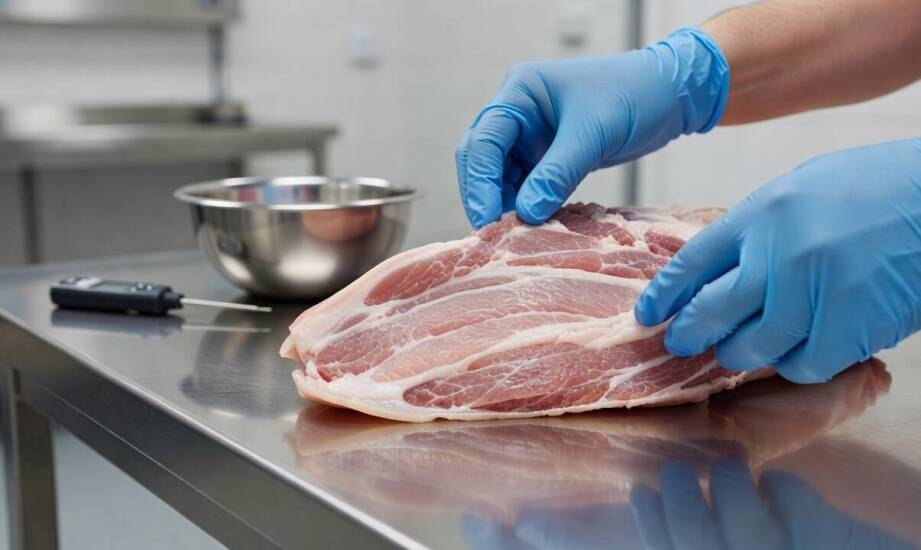
Pork mask can be used as a raw material in meat processing, but its technological suitability depends on the consistency of the parameters of a particular batch. The proportions of muscle tissue, fat and connective tissue, the degree of comminution and the temperature of the raw material are particularly important. Variations in these characteristics can affect the behaviour of the meat mixture during mixing, heat treatment and forming of the finished product.
Read more: How does a wholesale fruit & vegetable distributor support reducing food waste in gastronomy?
How Does the Composition of Pork Mask Affect Meat Batter Structure?
In a meat product formulation, each raw material contributes a certain amount of protein, fat, water and connective tissue. Changes in the way pork mask is prepared may therefore require corresponding adjustments to the process.
Consistency of the raw material composition is essential, because differences in fat or connective tissue content can change the properties of the meat mixture.
When ordering pork mask, an industrial customer should therefore consider not only the commercial name of the cut but, above all, the agreed specification.
This is particularly important in serial production, where successive batches should maintain technological properties that are as similar as possible.
Why Is Fat Content Important for Meat Batter?
Fat affects texture, juiciness and the behaviour of the meat mixture during comminution and heating, but the appropriate proportion depends on the formulation of the specific product.
A change in fat content can alter the consistency of the mixture, which is why raw materials should not be treated as fully interchangeable without considering their composition.
Michna Meat supplies fresh and frozen pork cuts prepared according to specified fat content or individual packaging requirements. Its product range includes both pork masks rind-on and pork masks rindless.
This distinction is technologically relevant because the presence of skin changes the proportion of connective tissue in the raw material and may therefore affect how subsequent processing should be carried out.
What Difference Does the Presence of Skin and Connective Tissue Make?
Skin is rich in collagen, whose properties change during heat treatment. For this reason, raw material containing skin will behave differently from the rindless variant, particularly in products where a specific degree of binding and texture is required.
The presence of skin should be taken into account in the formulation, rather than being treated solely as a commercial difference between two raw material variants.
The degree of comminution, meat batter temperature, mixing parameters and subsequent heat treatment are also important.
Collagen content alone does not guarantee product stability – the final result depends on the complete formulation and technological process. In the production of consistent meat products, maintaining similar characteristics of the raw material between deliveries is therefore particularly important.
How Do Temperature and Comminution Affect Consistency?
Even well-specified raw material can produce different results if the conditions of its preparation change.
The temperature of the meat batter needs to be controlled during processing, because the way comminution and mixing are carried out affects the behaviour of proteins, fat and water.
Particle size is also important. Different degrees of comminution change the distribution of individual components within the mixture and influence the structure of the finished product.
In an industrial processing plant, the pork mask specification should therefore be linked to an established method of preparation.
When changing supplier or batch parameters, the raw material should be assessed before automatically applying the existing process settings. This helps reduce situations in which changes in consistency are incorrectly attributed solely to the formulation.
Stable Meat Batter Starts with Controlled Raw Material
The effect of pork mask on meat batter results from its actual composition and the way it is subsequently processed.
Fat content, the presence of skin and connective tissue, temperature and degree of comminution should all be considered together.
A consistent raw material specification makes it easier to maintain a stable process, but it does not replace control of the technological parameters required for a particular meat product.
FAQ
What Is the Difference Between Pork Mask Rind-On and Pork Mask Rindless?
The main difference is the presence of skin and, consequently, a higher proportion of collagen-rich tissue.
This affects the technological properties of the raw material and should be taken into account when developing the product formulation.
Does a Higher Fat Content Always Improve Meat Batter Stability?
No. The appropriate proportion of fat depends on the type of product, the other ingredients and the production technology.
However, excessive variation in fat content can make it more difficult to achieve consistent properties between successive batches.
Why Is a Pork Mask Specification Important in B2B Production?
It defines the characteristics of the raw material that are relevant to the process and allows successive deliveries to be compared according to agreed criteria.
This makes it easier to control variability in the material entering production.
You might be interested

How does a wholesale fruit & vegetable distributor support reducing food waste in gastronomy?

What elements do a bishop's vestments consist of?

Is a Mitre One of the Basic Elements of a Priest’s Attire?